Production Kubernetes Deployment Strategies: What Actually Works After the Honeymoon Ends
The Rolling Update Mirage
Every Kubernetes tutorial starts with rolling updates. They’re the default deployment strategy, they look clean in demos, and they give you that warm feeling that you’re doing things “the Kubernetes way.” But here’s what those tutorials don’t tell you: rolling updates are a house of cards waiting to collapse the moment your application has any real complexity.
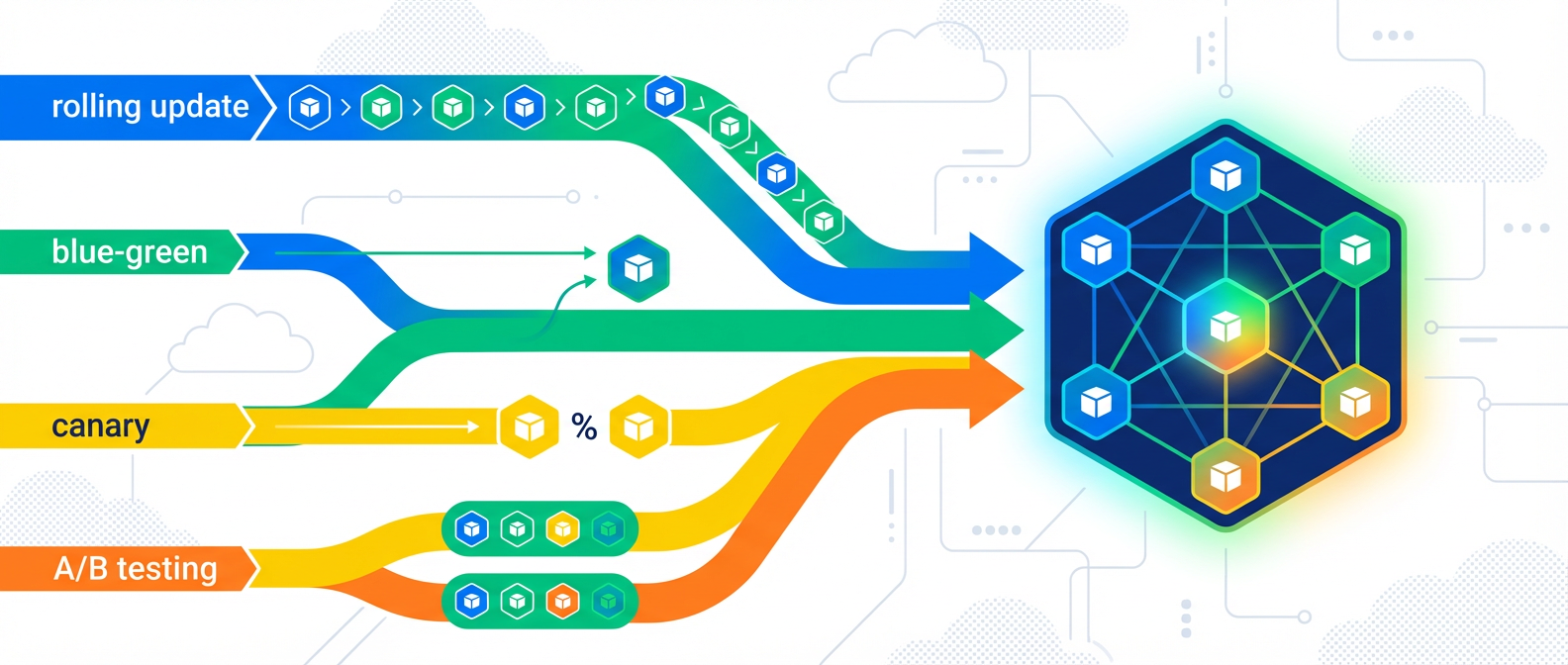
Rolling updates assume your new version plays nice with your old version at the protocol level. This sounds reasonable until you hit database migrations, API contract changes, or anything involving shared state. I’ve watched teams spend weeks debugging mysterious connection errors that only happened during deployments. The culprit? Their load balancer was routing requests to a mix of old and new pods that couldn’t talk to each other properly.
The maxUnavailable and maxSurge parameters give you some control, but they’re blunt instruments. Setting maxUnavailable to 0 sounds safe until you realize you’re doubling your resource usage during every deployment. Setting it higher means accepting downtime that you can’t predict or control. Neither option addresses the real issue: you’re mixing incompatible versions of your application in production.

Blue-Green: The Enterprise Darling That Costs More Than You Think
Blue-green deployments solve the compatibility problem by maintaining two complete environments and switching between them. In theory, this is elegant. In practice, it’s expensive and creates new failure modes that teams consistently underestimate.
The resource overhead is obvious. You need infrastructure for twice your production load, which means your cloud bill just doubled for the privilege of safer deployments. But the hidden costs are worse. Your monitoring systems now need to track two environments. Your service discovery needs to handle environment switches cleanly. Your database connections need to be drained and redirected without losing transactions.
I’ve seen blue-green implementations that work beautifully for stateless web services but fall apart the moment you introduce databases, message queues, or persistent volumes. The database becomes a single point of failure that couples your supposedly independent environments. Teams end up building complex database migration strategies that defeat the simplicity they were trying to achieve.
The switch itself introduces risk. You’re making a binary decision to route all traffic to the new environment based on limited testing. If something goes wrong, you’re not gradually rolling back a percentage of traffic, you’re doing an emergency environment switch under pressure. This is not the calm, controlled process that blue-green advocates promise.
Canary Releases: The Middle Ground That Demands Sophistication
Canary deployments split traffic between old and new versions, gradually shifting load as confidence builds. This approach acknowledges reality: you can’t predict every failure mode in staging, so you need a controlled way to test in production. But implementing canaries properly requires infrastructure sophistication that many teams lack.
The traffic splitting mechanism is critical. Simple random percentage-based routing isn’t enough for meaningful canary analysis. You need session affinity to prevent users from bouncing between versions. You need the ability to route specific user cohorts or geographic regions to the canary. You need detailed metrics broken down by deployment version. Building this properly means investing in service mesh technology or advanced ingress controllers.
Monitoring becomes everything with canary deployments. You’re not just checking if the new version works, you’re comparing its behavior against the current version in real time. This requires metrics pipelines that can slice data by deployment version, alerting systems that understand gradual rollouts, and dashboards that make it easy to spot subtle regressions. Teams that implement canary deployments without upgrading their observability infrastructure are flying blind.
The decision-making process is where many canary implementations fail. How long do you run the canary before promoting? What metrics do you use to make the decision? How do you handle edge cases where the canary performs differently but not necessarily worse? These aren’t technical problems, they’re process problems that require organizational maturity to solve.
When StatefulSets Change Everything
All the deployment strategies above assume your applications are stateless and horizontally scalable. StatefulSets (databases, message brokers, distributed storage systems) operate under different constraints that break most standard deployment patterns.
StatefulSets update pods one at a time by default, which sounds conservative but creates problems. A database cluster updating serially might lose quorum during the process. A Kafka cluster updating one broker at a time might create replication lag or partition reassignment storms. The ordered update process that seems safe actually introduces timing dependencies that can cascade into cluster-wide failures.
Persistent volumes add another layer of complexity. Your deployment strategy now needs to account for storage migration, backup timing, and data consistency across updates. I’ve seen teams attempt blue-green deployments with StatefulSets, only to discover that persistent volume claims can’t easily move between environments. The data layer becomes a constraint that forces you back toward rolling updates, whether you want them or not.
The solution isn’t to avoid StatefulSets, they’re necessary for many applications. The solution is to acknowledge that stateful applications need different deployment strategies, often involving application-specific logic for leader election, data replication, and gradual traffic shifting that’s aware of the underlying consensus protocols.
Building Deployment Strategy Around Your Actual Constraints
The choice of deployment strategy shouldn’t be ideological. It should be based on your application architecture, team capabilities, and failure tolerance. A simple web API that mostly handles read traffic can probably get away with rolling updates if you’re careful about database migrations. A real-time trading system needs the predictability of blue-green deployments despite the cost. A social media platform benefits from sophisticated canary deployments with feature flagging.
Most production systems end up with hybrid approaches. Critical user-facing services get canary deployments with gradual rollouts. Background job processors get rolling updates because brief disruptions are acceptable. Databases get maintenance windows and manual coordination because automation can’t handle every edge case.
The key insight is that deployment strategy is a system-level concern, not a service-level one. Your monitoring, networking, data persistence, and incident response all need to align with your chosen deployment patterns. Teams that treat deployment strategy as a checkbox item in their Kubernetes configuration inevitably run into problems when these components conflict during production incidents.
What deployment strategies have you found work reliably at scale? I’m particularly interested in hearing about hybrid approaches and how teams handle the operational complexity of managing multiple deployment patterns across different service types.

The IDE Wars in 2026: Which Tool Should You Actually Learn First

Zero-Knowledge Proofs: The Tech That Marketing Forgot
The Difference Between Decentralization and Distribution
About Author
