The Platform Engineering Burnout Crisis: When Kubernetes Complexity Becomes Technical Debt
The 73% Problem
I’ve been watching platform engineering teams for the better part of a decade, and what I’m seeing in 2026 isn’t sustainable. The Puppet State of Platform Engineering 2026 report landed on my desk last month with a statistic that made me pause: 73% of platform teams are working more than 50 hours per week. That’s not a badge of honor. That’s a system failure.

The report identifies Kubernetes configuration management as the primary burnout factor, and frankly, that tracks with every conversation I’ve had this year. I remember when we thought Kubernetes would solve infrastructure complexity. Instead, we’ve created a new type of complexity that requires specialized knowledge to navigate safely. The promise was developer productivity. The reality is platform engineer exhaustion.
What really gets me is that this isn’t a startup problem or a scaling problem. This is happening at mature organizations with dedicated platform teams, substantial budgets, and years of Kubernetes experience. If seasoned teams are struggling this much, we need to face facts: the complexity isn’t temporary.
The Scale of What We’ve Built
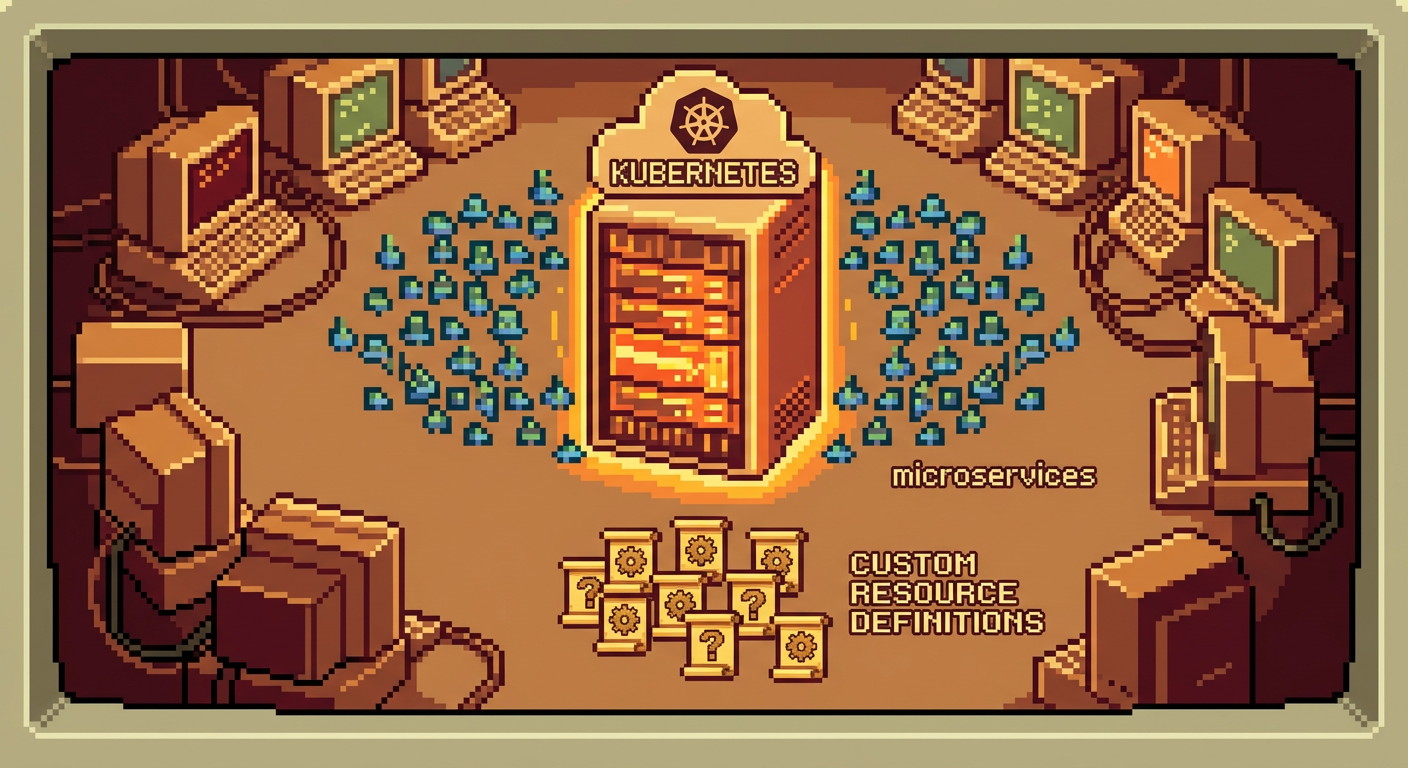
Let’s talk numbers for a moment. The Datadog Container Orchestration Survey found that the average enterprise Kubernetes cluster now manages 1,247 microservices with 340 custom resource definitions. Take a minute to absorb that. We’re not talking about a handful of services with some standard controllers. We’re talking about ecosystems of interdependent components that require constant care and feeding.
I’ve architected systems that seemed reasonable at the design phase but became operational nightmares six months later. What happens when you multiply that experience by 1,200+ microservices? You get platform engineers who spend their days firefighting instead of building. You get teams that understand individual components but can’t reason about how the whole system behaves.
The Custom Resource Definitions tell an even worse story. Each CRD represents a decision to extend Kubernetes in a domain-specific way. Some of these extensions are brilliant solutions to real problems. Others are abstractions built on abstractions, creating layers that make troubleshooting nearly impossible. When something breaks at 2 AM, you need engineers who understand not just Kubernetes, but your specific flavor of Kubernetes.
The Tool Proliferation Trap
The CNCF landscape has exploded to over 1,200 tools in 2026. I’ve watched organizations try to solve complexity with more complexity. The typical enterprise now uses 15 or more different cloud native technologies simultaneously. Each tool solves a specific problem, but the integration burden falls squarely on platform teams.
I’ve seen this pattern repeatedly: a team identifies a gap in their platform capabilities, evaluates tools, picks what appears to be the best solution, and then discovers the hidden integration costs. Every new tool needs configuration management, monitoring integration, security review, documentation, and training. The operational overhead compounds faster than the productivity gains.
This isn’t an argument against using multiple tools. Some problems genuinely need specialized solutions. But we’ve lost sight of the total cost of ownership. Platform engineers are becoming integration specialists rather than platform builders, and that shift is burning them out.
The Self-Service Plateau
Developer self-service was supposed to be our salvation. Build the platform once, let developers consume it independently, and watch productivity soar. Gartner tracked $2.3 billion invested in internal developer platforms in 2025, yet adoption has plateaued at 34%. That’s not a marketing problem or a training issue. That’s a complexity problem.
I’ve built self-service platforms that looked elegant in demos but crumbled under real-world usage patterns. Developers need predictable, reliable abstractions. When the underlying platform is constantly shifting due to tool updates, security patches, and feature additions, maintaining stable abstractions becomes a full-time job. Platform teams end up building custom solutions to hide complexity, which creates new complexity.
The Backstage story really drives this home. Spotify’s developer portal framework saw enterprise adoption drop 23% due to maintenance overhead. Teams reported spending 40% of their time customizing plugins rather than building core platform features. That’s backwards. The tool meant to simplify developer experience became another source of operational burden.
What Actually Works
After watching this space for years, I’ve seen teams that buck these trends. They share some common characteristics that are worth examining. They ruthlessly prioritize simplicity over feature completeness. They choose boring technology when possible and exotic technology only when necessary. They invest heavily in automation, but they automate simple processes rather than complex ones.
The most successful platform teams I know have also learned to say no. They resist the temptation to solve every developer problem with platform features. Instead, they focus on a smaller set of capabilities and execute them really well. They understand that a reliable, well-documented platform with limited features beats a comprehensive platform that needs constant maintenance.
These teams also invest in observability from day one, not as an afterthought. When you’re managing hundreds of microservices and dozens of tools, you need comprehensive visibility into system behavior. But they instrument for operational understanding, not just metrics collection. They build dashboards that help them reason about system health, not just display pretty graphs.
The sustainability question looms large over platform engineering in 2026. We’ve built systems that require superhuman effort to maintain, and we’re burning out the people who understand them. If you’re running a platform team, take an honest look at your team’s workload and stress levels. If you’re seeing the warning signs, it’s time to simplify before you lose the people who make it all work. What patterns are you seeing in your organization? I’m curious to hear how other teams are navigating this complexity crisis.

Why Your Blue-Green Deployment Will Fail in Production (And What Actually Works)
The Hidden Tax: How MEV Extraction Quietly Penalizes Regular Blockchain Users
Salt Typhoon’s Real Legacy: Why the 2026 Mandates Force Us to Rethink Network Architecture
About Author
