Why Semantic Versioning Isn’t Enough: A Battle-Tested Approach to API Evolution
The False Comfort of SemVer
Most teams reach for semantic versioning when they first confront the API versioning challenge. It feels natural. Breaking changes bump the major version, new features increment the minor, and bug fixes tick up the patch. Clean, logical, universally understood. I’ve watched countless engineering teams adopt this pattern with the confidence of people who’ve solved a hard problem.
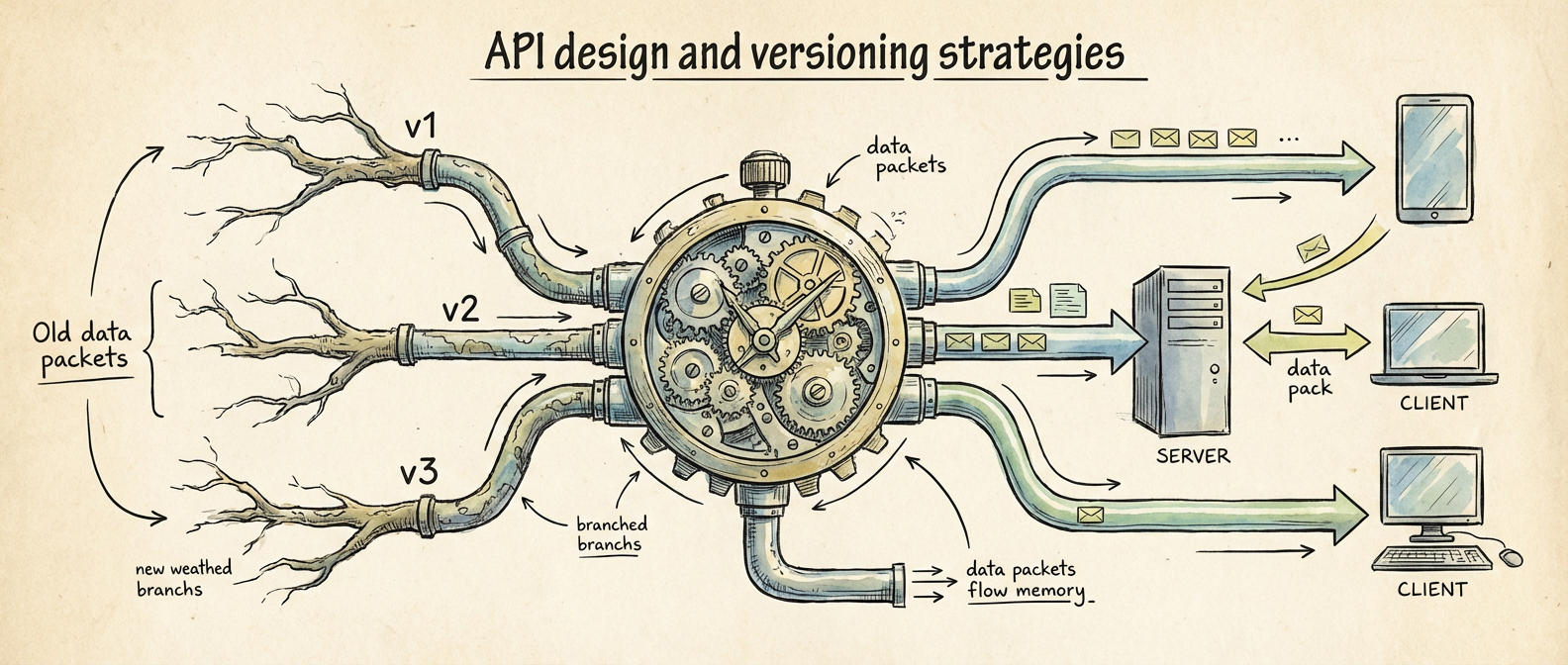
Reality hits six months later when you’re staring at version 4.12.3 of your API and trying to explain to your product manager why a “minor” change broke three client integrations. SemVer works beautifully for libraries where you control the upgrade cycle. For APIs consumed by external systems you’ll never meet? It becomes a promise you can’t keep.
The real issue isn’t with SemVer itself, but with the assumption that version numbers can capture the full complexity of backward compatibility in distributed systems. A field rename might be semantically minor but operationally catastrophic for a client that hard-coded those field names. Meanwhile, adding an entirely new endpoint could be a major feature release that touches zero existing integrations.

URI Versioning: The Path Most Traveled
URI-based versioning remains the most pragmatic choice for production APIs, despite its aesthetic critics. When you embed the version directly in the path, think `/api/v1/users` or `/api/v2/orders`, you create explicit contracts that both humans and tools can reason about. Every request declares its expectations upfront.
I’ve seen teams agonize over the “ugliness” of version numbers in URLs, usually while bikeshedding over header-based alternatives. This misses the forest for the trees. Your API consumers don’t care about URL aesthetics. They care about predictability, documentation that matches reality, and the ability to upgrade on their timeline, not yours.
The operational benefits compound over time. Load balancers can route traffic based on version. Monitoring systems can track adoption and performance per version. Support teams can immediately identify which version a customer is using from a single curl command. These aren’t theoretical advantages. They’re the difference between debugging an integration issue in minutes versus hours.
That said, URI versioning demands discipline around deprecation policies. Version proliferation becomes a maintenance nightmare if you don’t actively sunset old versions. I recommend establishing clear timelines upfront: version N-2 gets security patches only, version N-3 enters deprecation warnings, version N-4 goes dark. Communicate these timelines in your documentation and honor them religiously.
The Header Versioning Alternative
Header-based versioning offers a more refined approach that deserves serious consideration, particularly for APIs with sophisticated client ecosystems. Instead of cluttering URLs, you specify versions through Accept headers: `Accept: application/vnd.api+json;version=2`. This pattern separates resource identification from version negotiation, which appeals to REST purists and enables some elegant content negotiation scenarios.
The practical reality is messier. Header versioning works brilliantly when your clients are sophisticated enough to leverage it properly. I’ve seen it excel in B2B scenarios where integration teams have the bandwidth to implement proper content negotiation. The same pattern becomes a source of confusion and debugging complexity when you’re serving mobile apps, third-party widgets, or any client where developers might be working with limited HTTP libraries.
One underappreciated advantage of header versioning is its flexibility around partial version adoption. A client can specify that it supports version 2.3 of the user endpoint but only version 1.8 of the payment endpoint. This granular control becomes valuable for large APIs with independent feature evolution, though it requires considerably more sophisticated client-side version management.
Beyond Version Numbers: The Hypermedia Approach
The most resilient APIs I’ve encountered barely version at all. Instead, they embrace hypermedia principles where the server provides navigation links and capability discovery within each response. This approach treats your API as a living system rather than a static contract, allowing evolution without breaking existing clients.
Consider an API response that includes `”_links”: {“next”: “/api/users?page=2”, “edit”: “/api/users/123/edit”}` alongside the core data. Clients that follow these links automatically adapt to URL structure changes, new capabilities, and routing modifications. When you need to introduce a new field or deprecate an old one, you can do so gradually while providing transition paths through link metadata.
This isn’t a panacea. It requires client-side sophistication that many teams aren’t ready to build. But for APIs with long lifespans and diverse client ecosystems, hypermedia patterns provide evolutionary flexibility that traditional versioning schemes simply can’t match. I’ve watched APIs built this way handle major backend restructuring with zero client-side changes, purely because the clients followed server-provided links instead of hardcoding assumptions.
The key insight here is that versioning strategies aren’t mutually exclusive. The most robust APIs I’ve worked with combine explicit version contracts for major interface changes with hypermedia patterns for day-to-day evolution. You get the predictability of versioned contracts when you need it, with the flexibility of discoverable capabilities for everything else.
Practical Implementation Strategies
The version strategy you choose matters less than how consistently you implement it. I’ve debugged more API issues caused by inconsistent versioning policies than wrong versioning policies. Start with clear documentation that explains not just what your versioning scheme is, but why you chose it and how clients should adapt to changes.
Build versioning into your deployment pipeline from day one. Whether you’re using URI paths, headers, or hypermedia links, the infrastructure should make it trivial to deploy, test, and monitor multiple API versions simultaneously. I recommend treating each major version as a separate application from a deployment perspective, even if they share backend code. This separation makes it much easier to reason about performance, security, and deprecation timelines.
Most importantly, establish feedback loops with your actual API consumers. Version adoption metrics, error rates per version, and direct communication with integration teams provide ground truth about whether your versioning strategy is working in practice. The best versioning scheme on paper becomes useless if your clients can’t or won’t adopt it successfully.
Every API evolves differently based on its consumers, constraints, and organizational context. The patterns I’ve outlined here aren’t prescriptions, they’re tools for thinking through the tradeoffs in your specific situation. What versioning challenges are you facing in your APIs? I’d be curious to hear about approaches that have worked (or failed spectacularly) in your experience.

GitHub Copilot Workspace’s Agentic Mode: The Productivity Gain Nobody’s Accounting For Yet

Core Web Vitals in 2026: Your Complete Guide to Modern Web Performance
The Hidden Tax: How MEV Extraction Penalizes Regular Blockchain Users
About Author
